Absolute Return vs CAGR vs XIRR
In this article we would cover:
- What is Absolute return, CAGR, XIRR
- Their limitations
- Why does it make sense to use XIRR
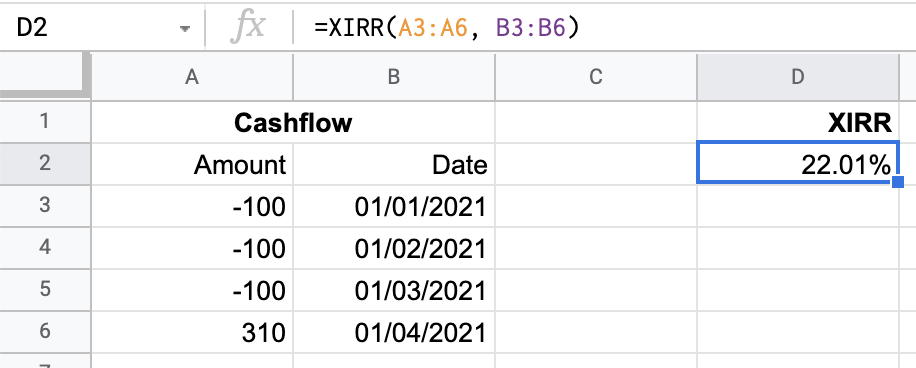
We will use this sample portfolio as an example -
Sundar invested Rs. 100 every first day of the month for three months. He then exited the portfolio at Rs. 310 exactly after three months.


A negative value represents outflow/investment/loss (money going out from your pocket). And Positive value represents the inflows/profit (money coming in your pocket).
Absolute Return
Absolute return is the most basic way to calculate returns from an investment. It does not take the time factor into consideration. It simply considers only the amount gained/lost from an investment.
Sundar's absolute return would be
CAGR (Compounded Annual Growth Rate)
CAGR is a common metric used in the financial industry to calculate the annualized return of an investment.
While CAGR considered the overall duration of investment, it still does not work for more than two transactions —
In the above calculation, 0.25 = one quarter
This calculation assumes that Sundar invested Rs. 300 on Jan 1st and received Rs. 310 on Apr 1st, 2021. Which is not correct.
XIRR (eXtended Internal Rate of Return)
Internal Rate of Return (IRR) is used to calculate annualized returns when the transactions happen periodically (say, Mutual Fund SIP set for 1st day of every month).
XIRR is an extended version that works for non-periodic transactions.
Both, IRR & XIRR, considers timing of individual transaction for calculating annualised returns.
Considering the complexity of the XIRR calculation, I will leave it up to you for further reading (check references).
There is a great utility function provided by MS Excel & Google Sheet - XIRR()